Chapter 2 of 8
Get to Know Your Cards
Meet the Major Arcana, four suits, and court cards.
About 4 min read · Practice at your own pace
In this chapter Identify the main groups in a tarot deck.
On this page
A map of the deck
A deck can feel less overwhelming once you see how its cards are organized. You can learn the structure first and return to individual meanings as you encounter them.
A standard modern tarot deck has 78 cards: 22 Major Arcana and 56 Minor Arcana. The Minor Arcana has four suits, each containing an Ace, cards Two through Ten, and four court cards. Think of this structure as a map that helps you find your way through a reference.
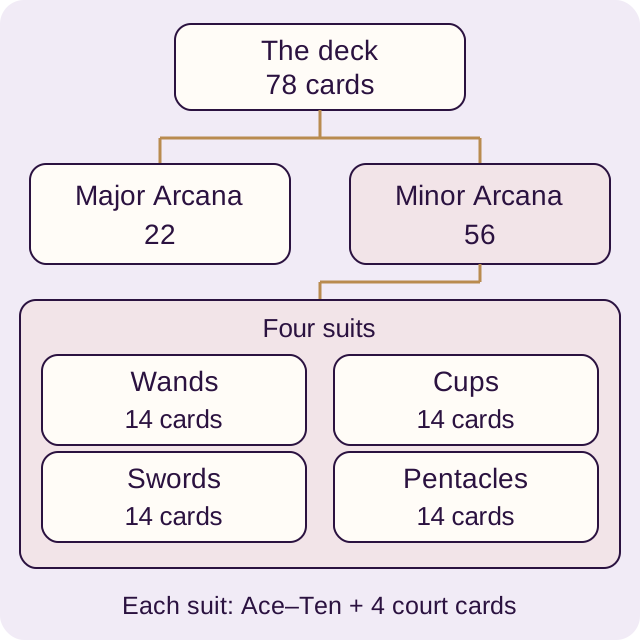
Each suit includes Ace through Ten and four court cards: 10 + 4 = 14.
InnerSigns learning diagramsEach suit has ten cards from Ace through Ten, plus four court cards: 10 + 4 = 14. The four suits together make 56.
The Major Arcana
The Major Arcana includes cards such as The Fool, Strength, The Hermit, and The Star. Their names and images suggest themes that readers often connect with significant experiences: beginning, choosing, changing, or reconsidering a direction.
You may see a number on these cards. In the Rider–Waite–Smith sequence, The Fool is numbered 0 and The World is XXI, or 21. Some decks use different numbering or names.
When a Major Arcana card appears, consider its theme in relation to your question. Strength might invite reflection on patience during a conversation; The Hermit could open a question about making room to think. A card’s place in this group does not measure how important your situation must be.
Four suits, everyday starting points
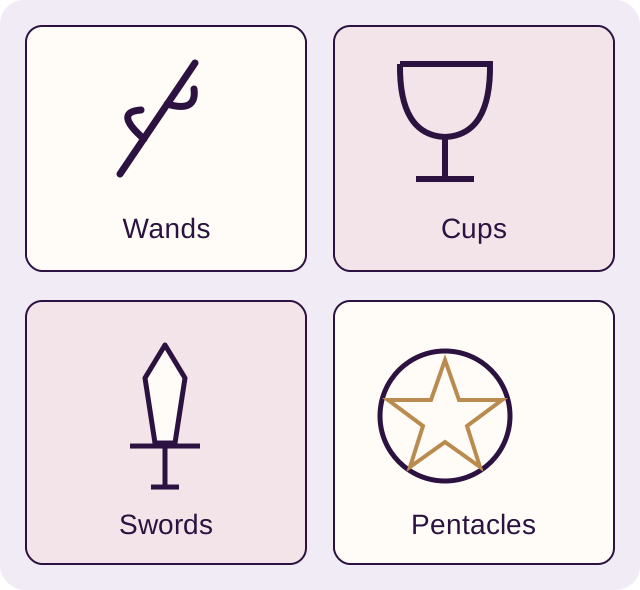
The four suits offer starting points for reflection. Their names and associations are explained below.
InnerSigns learning diagramsThe Minor Arcana gives you four groups of images and associations to explore. Here are useful starting points:
- Wands
- Common associations: Energy, initiative, creativity, action · An everyday question to explore: Where could I direct my effort?
- Cups
- Common associations: Feelings, relationships, connection · An everyday question to explore: What matters to me in this connection?
- Swords
- Common associations: Thoughts, communication, conflict, decisions · An everyday question to explore: What needs clearer thinking or discussion?
- Pentacles
- Common associations: Practical resources, work, time, material life · An everyday question to explore: What would help me make this workable?
These associations overlap. A work question might involve feelings as well as practical resources. A Cups card can therefore be relevant to a career reading, just as a Pentacles card can prompt reflection on the time and effort a friendship needs.
Some decks call Pentacles “Coins,” Cups “Chalices,” or use other names. Check the guidebook to see how your deck organizes them.
Numbers and court cards
Each suit begins with an Ace and continues through Ten. An Ace is often read as an opening or possibility connected with its suit. The Ace of Wands, for example, can suggest an idea you feel interested in developing.
For the other numbered cards, begin with the image and the reference. Number patterns can be useful later, but a number alone gives you limited context. The Four of Cups and Four of Wands have distinct scenes and meanings even though they share a number.
In the Rider–Waite–Smith deck, each suit contains a Page, Knight, Queen, and King. Other decks may rename these roles.
Court cards can be approached as people, qualities, or ways of engaging with a situation. For this beginner practice, try reading them as qualities you could explore.
A Page may suggest a learner’s curiosity; a Knight, an active approach; a Queen, attentive cultivation; a King, responsible direction. These are teaching starting points, and each suit adds its own character.
Anyone can explore any court card. A Queen need not refer to a woman, and a King need not refer to a man. You can consider how the quality fits without assigning it to a person.
Find your way around
Compare The Star, a Major Arcana card, with the Two of Cups, a numbered Minor Arcana card. Either can help you reflect on friendship; the question and context guide the connection.