Chapter 4 of 8
Ask Questions That Bring Clarity
Give your reading a focused, open question.
About 3 min read · Practice at your own pace
In this chapter Rewrite a broad question into one you can explore.
On this page
Start with what you know
A useful question gives your reading a direction. It helps you decide which parts of a card’s meaning relate to the situation you want to explore.
Start with one subject. Perhaps you are preparing for a conversation, considering a new commitment, or trying to begin a task. Write a sentence about what is happening using facts you already know.
“My friend and I have struggled to make plans recently” gives you a clear starting point. “My friend no longer cares about me” adds an assumption you would need to check directly.
Give yourself room to respond
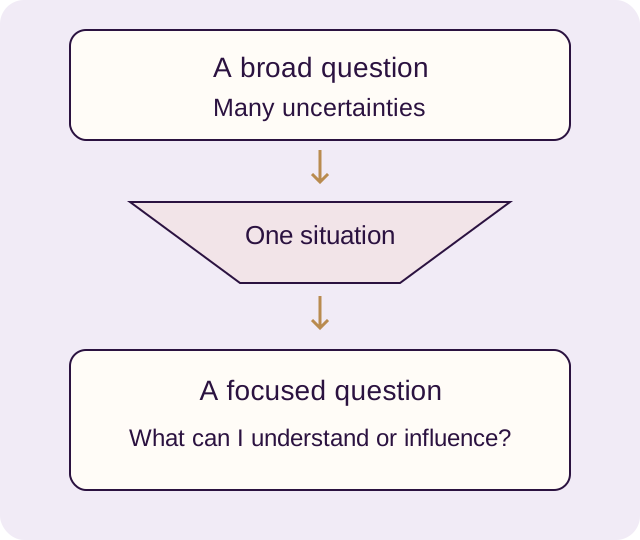
Narrow the subject, then ask about your own approach. See the question pairs below.
InnerSigns learning diagramsOpen questions often begin with “What,” “How,” or “Which.” They make room for possibilities and keep your choices visible.
For example:
- Will they text me?
- A question to explore in a reading: What do I need from this connection, and how could I communicate it?
- Will I get the job?
- A question to explore in a reading: What could I strengthen as I prepare for this opportunity?
- Why is everything going wrong?
- A question to explore in a reading: Which part of this situation needs my attention first?
- Should I say yes to this invitation?
- A question to explore in a reading: What would help me decide whether this commitment fits?
- When will I feel inspired again?
- A question to explore in a reading: What could help me reconnect with something I enjoy?
These questions guide reflection. You will still need a conversation, an application outcome, or practical information to answer the original uncertainty.
Keep the question manageable
“What should I do with my life?” can be difficult to work with because it includes so much. Narrow the scope to something you can examine today: “What deserves attention as I consider my next work step?”
You can also ask about your approach. “How could I prepare to discuss our shared responsibilities?” lets you reflect on communication without asking a card to speak for someone else.
If your question contains several problems, choose one for this reading. Save the others in your notebook. A smaller question makes it easier to explain the connection you eventually find.
Write the question before drawing and leave it beside the card. An unfamiliar meaning may tempt you to follow an entirely different subject. Return to the words you chose and ask how the interpretation relates.
You can decide later that another question deserves attention. Record that as a new question rather than quietly changing the purpose of the original reading.