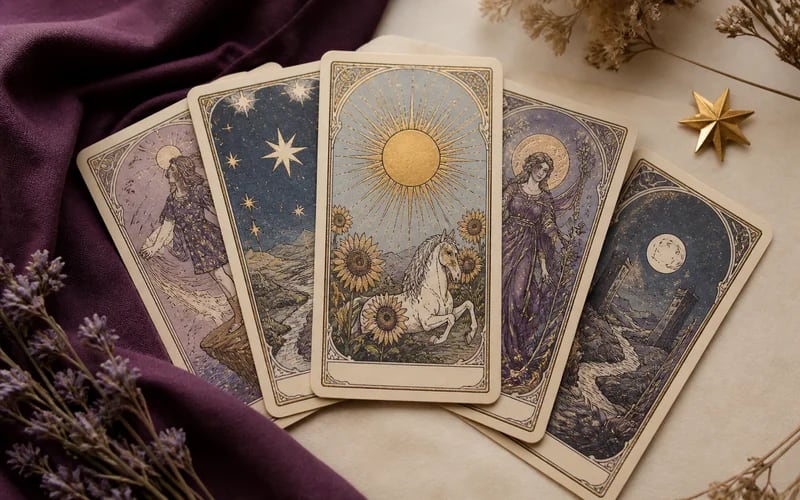
Choose a tarot deck by checking six things: what you want to use it for, how it is structured, whether its images are readable to you, what its guidebook explains, whether you can handle and see the cards comfortably, and whether the contents and price fit your needs.
A fully illustrated Rider–Waite–Smith-style deck often matches beginner books and card references closely. It is not the only valid first choice. A pip-style, Thoth or more original deck can also work when you understand what differs and have learning material written for it.
You do not need a perfect deck or a large collection. You need one deck whose choices you can recognise and whose cards you can actually use.
Start with what you want the deck to help you do
Before comparing artwork, finish this sentence:
I want this deck for ____. It must ____ and ____. I would prefer ____ and ____.
Your answer might be “weekly one-card practice”, “learning traditional card structure”, “studying visual symbolism” or “enjoying the deck as an art object”. Each purpose changes the decision.
For an image-led first practice, clear scenes and a useful guidebook may be non-negotiable. For historical study, a pip-style deck and a tradition-specific book may be exactly what you want. For travel, dimensions and a secure box may matter more than large artwork.
Keep must-haves separate from preferences. “I can read the card titles” is a possible requirement. “The palette uses soft greens” is a preference. This distinction makes it easier to compare two appealing decks without expecting either to satisfy everything.
If your goal is to complete your first reading, the beginner’s guide to reading tarot cards shows the next steps. This article stays with choosing and understanding the deck itself.
Check that it is the kind of deck you expect
The word deck does not tell you how the cards are organised. Check the card list, sample images and publisher’s description rather than relying on the box theme alone.
Tarot or oracle?
A standard modern tarot deck contains 78 cards: 22 Major Arcana and 56 Minor Arcana. The Minor Arcana is divided into four suits, usually with Ace through Ten and four court cards in each. The Victoria and Albert Museum’s history of tarot cards explains this familiar structure and shows how widely the imagery can vary.
Oracle decks set their own card count, names and organising system. That flexibility is not a flaw, but an oracle deck will not map automatically to a guide written for tarot’s Major and Minor Arcana.
If you want to learn tarot, confirm that the product is a complete tarot deck rather than assuming any illustrated divination cards use the same structure. Some specialist or art editions may contain only the Major Arcana or add extra cards; the included guidebook should explain what is present.
Illustrated or pip-style Minor Arcana?
In an illustrated Minor Arcana, a numbered card contains a scene with figures, objects or actions. In a pip-style Minor Arcana, the numbered cards may primarily arrange the relevant suit symbol—for example, five cups—without a narrative scene.
Pamela Colman Smith’s artwork for the Rider–Waite–Smith deck, first published in 1909, gave the Minor Arcana fully illustrated scenes that influenced many later decks, according to the V&A. A reader who learns by describing pictures may find this style requires less translation between the card and RWS-based resources.
A pip-style deck is not incomplete or inferior. It places more weight on number, suit, arrangement and the method taught by its guide. If that approach interests you, choose suitable learning material instead of expecting every RWS image description to appear on the card.
Which system and names does it use?
Deck listings may describe a deck as Rider–Waite–Smith-inspired, Marseille-style, Thoth-based or original. These labels can point to differences in imagery, card titles, suit names, court ranks and numbering. Labyrinthos provides a useful introductory comparison of RWS, Marseille and Thoth conventions, but modern decks may adapt or combine conventions.
Check the individual deck. Look at Strength and Justice, the four suit names and the court cards. Note whether cards have been renamed and whether the guidebook explains why. A theme—cats, plants, a fictional world or a particular art style—does not by itself tell you which structure the deck follows.
For the familiar card groups, see the InnerSigns guides to the Major Arcana and Minor Arcana.
Use the six-check deck fit test
Use product images, a shop sample, a borrowed deck or a video showing the full deck. Record yes, no or not yet verified for each check.
1. Purpose
Does the deck support the use you named? A deck chosen for visual study needs enough sample imagery to judge. A deck chosen for portable practice needs a size and container you can carry.
2. Structure
Can you confirm the card count, system, illustrated or pip-style Minors, titles and numbering? Do your intended learning resources use the same conventions, or are you comfortable translating between them?
3. Image readability
Do not judge only by the Fool or the box cover. Preview at least one Major, several numbered Minors from different suits and a court card.
Ask whether you can distinguish the cards, read any printed titles and describe what is happening. Artwork can be beautiful while still being too abstract, crowded, dark or small for the way you want to study. That is a fit issue, not a verdict on the artist.
4. Guidebook fit
Find out what “guidebook included” means. Does it explain every card or offer only keywords? Does it discuss this deck’s renamed cards, added symbols and changed structure? Is it written in a language and type size you can use?
A long book is not automatically clear, and a short booklet is not automatically inadequate. Preview the contents or a sample entry when possible. The useful question is whether it explains the choices made in the cards you will hold.
5. Physical access
Check the actual card dimensions rather than relying on “standard”, “mini” or “large”. Consider the width, print size, contrast, glare, surface texture and weight of the complete stack.
If possible, handle a sample. You do not have to riffle-shuffle: an overhand shuffle, mixing cards face down on a clear surface or another comfortable method can work. The aim is to use the cards without strain, not perform a particular technique.
6. Practical fit
Confirm what the price includes: cards, guidebook, box or other stated materials. Check the language, seller or publisher, return terms where relevant, and whether the people and situations in the art feel usable for your reflective practice.
Stay within the budget you set before browsing. Price, gilded edges and elaborate packaging do not prove that a deck will suit your learning method.
Hypothetical worked example: two appealing decks, one clearer fit
This is an invented comparison, not a review of real products or a record of a purchase.
An imagined beginner wants a deck for weekly one-card practice alongside InnerSigns. Their two must-haves are image-led numbered cards and comfortable handling. They would prefer nature-themed art and a detailed guidebook, and they have set a fixed budget.
They compare two fictional products.
Deck A is described as a complete 78-card RWS-style deck. The sample images show illustrated Minor Arcana, familiar card names and readable scenes. Its book explains each card and the artist’s nature symbolism. In a shop sample, however, the cards are too wide for the reader to handle comfortably.
Deck B is a compact 78-card Marseille-style deck with art the reader enjoys. Its numbered Minors use pip arrangements. The included leaflet offers short keywords but does not explain how to build meanings from number, suit and arrangement.
Their comparison note is:
| Check | Deck A | Deck B |
|---|---|---|
| Purpose | Yes: image-led learning | Not yet: different reading method |
| Structure | Yes: familiar RWS-style labels | Yes, but pip-style Minors |
| Images | Yes: scenes are readable | Appealing, but fewer narrative scenes |
| Guidebook | Yes: deck-specific explanations | No for current needs: short keywords only |
| Physical access | No: uncomfortable width | Yes: comfortable size |
| Practical fit | Within budget | Within budget |
Neither deck meets both must-haves. That does not make either a poor deck. It means the reader does not yet have a clear fit.
They check whether Deck A has a smaller authorised edition and whether a fuller beginner guide exists for Deck B’s system. If neither option resolves the mismatch, they wait and compare another deck. “Not yet” prevents an appealing purchase from becoming an uncomfortable or confusing learning tool.
Understand a new deck before your first reading
When the deck arrives, make a short deck map before trying to memorise meanings:
- Read the creator or publisher’s introduction.
- Identify the Major Arcana, numbered Minor Arcana and court cards.
- Record renamed cards, unusual numbering and extra cards.
- Note whether the Minors use scenes, pips or a mixture.
- Compare one card with the deck’s guidebook and a familiar reference.
You might write:
- System stated: RWS-inspired.
- Minor Arcana: illustrated scenes.
- Changes: Coins replaces Pentacles; two extra cards are explained in the guidebook.
- Guidebook strength: describes the new plant symbols.
- Difference from my reference: the picture changes, while the card’s position in the deck remains recognisable.
Use the InnerSigns card library to preview familiar names and structure, but let the deck-specific guidebook explain its own art. If a flower, animal or gesture appears only in your deck, do not assume a generic reference knows why the creator placed it there.
For help separating visible detail, source meaning and personal application, see how to interpret tarot cards in context.
Common first-deck mistakes
- Choosing from box art alone: preview numbered Minors and courts as well as famous Major cards.
- Confusing theme with system: a modern theme can still follow RWS, Marseille, Thoth or another structure.
- Assuming every guide matches every deck: check which imagery and naming the resource uses.
- Ignoring handling and readability: dimensions, contrast, type size and glare can matter more than decorative finish.
- Treating price as proof of fit: production details and suitability are different questions.
- Buying several decks before learning one: begin with one clear choice, then let actual use show what you want next.
You may also hear that a first deck must be a gift. You are free to honour that custom if it matters to you, but buying a deck yourself does not change its contents or prevent you from learning with it. No gatekeeper is required.
Choose one deck, then begin simply
Make the decision from your must-haves, not from pressure to find a lifelong deck. Your preferences may change as you learn.
Once you have a workable choice, read its guidebook introduction and study one upright card. Describe one visible detail, check one source theme and write one possible question. That is enough for a first meeting with the deck.
Before buying—or while waiting for a deck to arrive—you can explore all 78 tarot cards to become familiar with the structure and names InnerSigns uses.