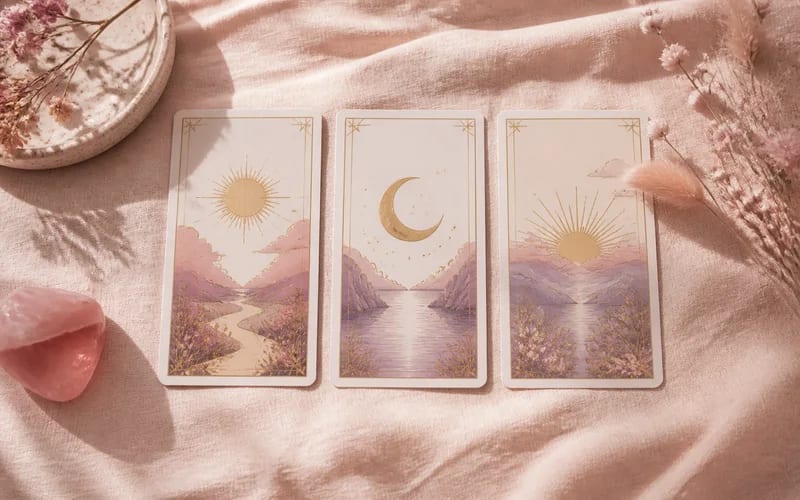
The Minor Arcana are the 56 suited cards in a standard 78-card tarot deck. They are organised into four suits—Wands, Cups, Swords and Pentacles—with 14 cards in each. Every suit contains Ace through Ten, followed by Page, Knight, Queen and King.
Tarot readers often use these cards to explore everyday experiences: a conversation, a project, a feeling or a practical concern. You can begin learning them through their shared structure, then consult individual meanings for the details that structure cannot supply.
How the 56 Minor Arcana cards fit together
Each suit follows the same sequence:
Ace, Two, Three, Four, Five, Six, Seven, Eight, Nine, Ten, Page, Knight, Queen, King.
Ace through Ten form the numbered group. Page, Knight, Queen and King are the court cards: four named ranks within each suit. That gives you four suits × (10 numbered cards + 4 court cards) = 56 cards. The court cards are included in that total. Biddy Tarot’s Minor Arcana reference describes this structure.
For example, the Seven of Cups is a numbered card in the Cups suit. The Queen of Cups belongs to the same suit but is a court card. If you encounter the term pip cards, it refers here to the Ace-through-Ten group.
The remaining 22 cards are the Major Arcana. A common reading convention associates the Majors with broad themes and the Minors with everyday details. “Minor” does not establish that a concern is unimportant, temporary or easy to change.
This guide uses Rider–Waite–Smith-style suit and rank names. If your deck uses different names, check its guidebook for the intended structure and associations before assuming a direct match.
The four suits as starting points
A suit offers a broad area to explore. These associations are interpretive conventions, rather than facts a card reveals about your situation. The elemental correspondences below are described in Little Red Tarot’s Minor Arcana introduction.
| Suit | Symbolic element and focus | A question to explore |
|---|---|---|
| Wands | Fire; motivation, initiative and creative activity | What am I willing to put effort into? |
| Cups | Water; feelings and relationships | What can I describe about my own response? |
| Swords | Air; thinking, communication and conflict | What needs a clearer explanation? |
| Pentacles | Earth; work, resources and practical activity | What materials or practical steps does this need? |
The elements are symbolic associations, not literal forces acting through the cards. The questions are suggestions for reflection, not additional traditional meanings.
Avoid making each suit an exclusive category. Pentacles can prompt consideration of materials or practical work without being about money. Cups can concern friendship or your own feelings without being about romance. Swords do not automatically announce an argument.
One ordinary situation may involve several of these areas. Planning a shared meal, for instance, involves ideas, communication, relationships and ingredients. The suit offers a starting perspective; your question and the individual card help make it specific.
Stay with what you can know. A Cups card cannot establish someone else’s feelings, and a suit associated with thoughts or physical life cannot diagnose a condition.
Use numbers as clues, then read the individual card
Some readers use number patterns to help organise their study. Aces, for example, are often associated with beginnings or possibilities. Such a pattern can give you somewhere to start, but it does not prove that an opportunity is about to arrive.
The limitation becomes clearer when you compare cards sharing one number. Consider these two eights as separate study examples:
- Eight of Pentacles: Work and craftsmanship are starting themes. Waite describes a stone artist at work and lists craft-related meanings in his Eight of Pentacles entry.
- Eight of Cups: Waite describes someone leaving the cups behind. His entry also acknowledges contrasting interpretations, so even that description is not the whole meaning. See his Eight of Cups entry.
Modern references such as Labyrinthos also distinguish these cards through craft-related and leaving-behind themes. Calling every eight “mastery” would miss a useful difference.
You do not need to force both cards into one definition of eight. Record the shared number, then examine the particular card and a suitable reference. These are separate cards being compared for study, not a pair drawn together for a reading.
If a number-based shortcut clashes with your deck’s imagery or explanation, keep the difference visible in your notes. “My number shorthand does not explain this detail” is a useful observation. For more practice separating a card’s source meaning from its application, see how to interpret tarot cards in context.
Court cards can describe an approach
A court card does not have to represent a particular person. Readers may explore it as a role, a quality or an approach to a situation. Carrie Mallon’s court-card guide discusses these possibilities and explains why age and gender need not be taken literally.
Here is one simplified way to begin thinking about the ranks:
| Rank | One possible approach to explore |
|---|---|
| Page | Being curious and beginning to engage with the suit |
| Knight | Pursuing or putting the suit’s concerns into action |
| Queen | Embodying and tending the suit’s qualities |
| King | Directing or taking responsibility for the suit’s concerns |
This is a set of study prompts, not a universal ladder of personality types. Check the individual card’s reference before applying the shorthand. A general idea about Knights, for instance, will not explain every Knight in every context.
You can ask, “What would it mean to approach this with curiosity?” without deciding that a Page must be a child. A Queen or King does not need to match anyone’s gender, and the title does not rank their human worth.
If you choose to consider a court card in relation to someone you know, distinguish your interpretation from evidence about that person. The card cannot verify their motives, feelings or intentions.
Hypothetical worked example: Eight of Pentacles and a handmade card
This example uses invented circumstances and a deliberately selected card. It is not a real draw or prediction. You could arrange it as a study with a physical deck.
Someone is making a handwritten birthday card. Their first draft has uneven letter spacing. They have spare paper and a reference alphabet they have already chosen. The birthday is next week, leaving time to revise.
Their question is: “What approach could help me with the lettering?”
The selected card is Eight of Pentacles, upright, in one position labelled “An approach to consider.”
Identify what each clue contributes
Classification: This is a numbered card—eight—in the Pentacles suit. That places it within the Minor Arcana structure.
Suit clue: The suit’s association with practical activity makes materials and hands-on work relevant possibilities. It does not, by itself, tell the maker what to do.
Specific card theme: Waite’s craft-related interpretation gives a more focused subject to consider. His description concerns a stone artist, not someone lettering a birthday card. Applying craftsmanship to lettering is the maker’s interpretation.
Known circumstance: The uneven spacing is already visible in the draft. The card has not discovered the problem.
Turn the theme into a possible action
The maker could use craftsmanship as a prompt to practise one short line on spare paper, then compare the spacing with their chosen reference before returning to the birthday card.
The exact action comes from the known problem and available materials. It does not come from treating eight as a hidden instruction to make eight attempts, work for eight minutes or follow a particular technique.
After trying the line, the maker can inspect the result and decide whether to keep or revise it. The reading does not establish how the lettering will turn out or whether the recipient will like it.
Keep a complete note
- Card: Eight of Pentacles; numbered Minor, upright.
- Sourced theme: Craftsmanship.
- Known fact: My draft has uneven letter spacing.
- Possible action: Practise a short line on spare paper and compare it with my reference.
- Still unknown: Whether I will prefer the next attempt.
No successful outcome is assumed. The example shows how a suit provides orientation, a specific card adds detail and the actual circumstances shape an action.
Practise recognising the structure
Choose one numbered Minor and one court card from a physical deck or the InnerSigns card reference. Identify the suit and number or rank of each.
Before reading the full explanation, write one possible theme based on what you have learned. Then consult the card’s reference and note something your shorthand missed, complicated or left unclear. Keep the reference meaning distinguishable from your own application.
You might end with: “The suit helped me notice ___, but this particular card also asks me to consider ___.” If nothing fits your circumstances, leave it as a study note. You can learn the structure without turning every card into an instruction for your life.