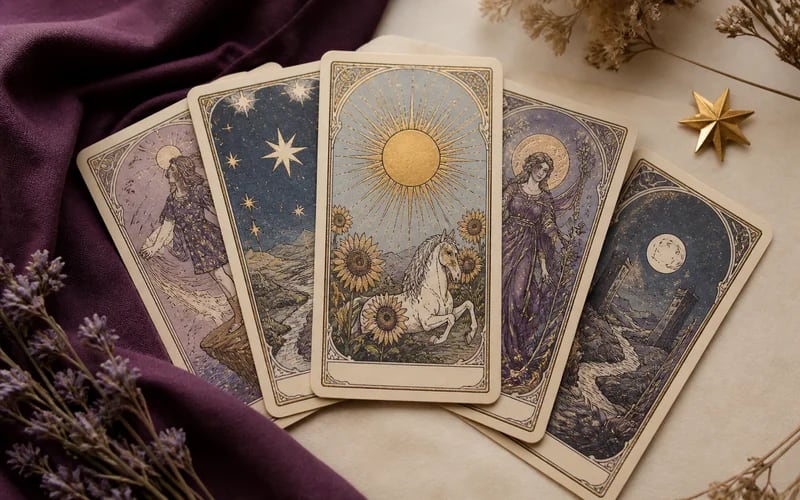
The Major Arcana are a group of 22 cards within a standard 78-card tarot deck. They include the Fool, the Lovers, Death and the World. Tarot readers commonly explore them through broad themes such as beginnings, relationships, change and completion.
This guide lists all 22 in Rider–Waite–Smith order, from the Fool at 0 to the World at XXI. Each theme is a starting point for interpretation, with a question you can adapt to your circumstances. You do not need to memorise every meaning before beginning.
What are the Major Arcana?
A standard tarot deck contains 22 Major Arcana cards and 56 Minor Arcana cards. A common teaching approach connects the Majors with broad themes and the Minors with everyday details. This is an interpretive convention: the distinction does not mean everyday concerns are less important. Little Red Tarot’s introduction explains this approach.
You may also see the Major cards described as archetypes: recognisable symbolic characters or patterns. The Hermit, for example, can provide a starting point for thinking about reflection. That does not make drawing the Hermit evidence that you should isolate yourself.
Use the theme alongside your question and anything you actually know about the situation. A card can offer a subject to explore without establishing what is happening or what will happen next.
The 22 Major Arcana cards in order
The short themes below draw on modern interpretations presented by Labyrinthos and Biddy Tarot. They are selective summaries, not complete meanings. The reflection questions are suggestions for applying those themes, rather than traditional definitions.
| Number and card | Starting theme | A question to explore |
|---|---|---|
| 0 — The Fool | Beginnings; openness | What small experiment could I try with sensible preparation? |
| I — The Magician | Resourceful action | Which available skill could I put to use? |
| II — The High Priestess | Inner attention | What am I noticing, and what still needs checking? |
| III — The Empress | Nurturing; growth | What would benefit from consistent care? |
| IV — The Emperor | Structure | Where would a clear boundary help? |
| V — The Hierophant | Tradition; learning | Which inherited rule deserves a closer look? |
| VI — The Lovers | Relationships; values | Which choice fits the values I can name? |
| VII — The Chariot | Directed effort | Where do I want to concentrate my effort? |
| VIII — Strength | Courage; compassion | How could I be firm while remaining considerate? |
| IX — The Hermit | Reflection | What needs time for private consideration? |
| X — Wheel of Fortune | Changing cycles | What can I adjust as circumstances change? |
| XI — Justice | Fairness | What would a fair account include? |
| XII — The Hanged Man | Pause; perspective | What might I notice from another viewpoint? |
| XIII — Death | Endings; transition | Is there an ending I need to acknowledge? |
| XIV — Temperance | Moderation | What manageable adjustment could I try? |
| XV — The Devil | Attachment; restriction | Which commitment or habit deserves examination? |
| XVI — The Tower | Upheaval | Which assumption should I check against current facts? |
| XVII — The Star | Hope; renewal | What gives me a realistic reason to keep going? |
| XVIII — The Moon | Uncertainty | What do I still need to find out? |
| XIX — The Sun | Joy | What can I appreciate in the present? |
| XX — Judgement | Review; awakening | What have I learned that could inform my next choice? |
| XXI — The World | Completion | What is finished, and what would mark its completion? |
Pick the entry you need rather than trying to answer all 22 questions. If a prompt does not fit, leave it aside. Drawing Death does not oblige you to find something to end, any more than drawing the World proves a task is finished.
Your deck’s guidebook may emphasise another aspect of a card. Start by understanding that explanation before combining it with meanings from elsewhere. This list concentrates on starting themes rather than a separate set of reversed interpretations.
Why might my deck use different numbers?
This list places Strength at VIII (8) and Justice at XI (11). That follows the numbering in A. E. Waite’s The Pictorial Key to the Tarot.
In his Strength chapter, Waite explicitly says he interchanged Strength with Justice, which he describes as usually numbered eight. A deck using Justice VIII and Strength XI is therefore using a different arrangement, not necessarily making a mistake.
Check your deck’s own numbering when looking up a card. Also remember that the Fool’s zero means the World, numbered XXI (21), is the twenty-second card in this list.
The Fool’s journey is one way to study the sequence
The Fool’s journey treats the cards as encounters in a symbolic story, beginning with the Fool and reaching completion with the World. You can use that narrative to explore how themes relate: beginning something, meeting unfamiliar ideas, making choices and considering what completion might mean.
Treat it as an optional study aid. It does not require your life to follow the cards in order, or mean you must undergo each theme before moving on. You can also study an individual card without placing it in a larger story.
For a closer look at the sequence’s endpoints, explore the Fool and the World.
Reading difficult themes without predicting disaster
Names such as Death, the Devil and the Tower can sound alarming. Keep the difference between a theme and a factual conclusion clear:
- Death: An ending or transition can be a subject for reflection. The card does not establish that someone will die or that you must end a relationship.
- The Devil: Attachment or restriction can prompt a question about what holds your attention. The card cannot diagnose addiction, establish wrongdoing or show that a real restriction is merely imagined.
- The Tower: Upheaval can prompt you to examine an assumption. Drawing it does not confirm that disaster is approaching.
You do not have to turn these themes into promises that something better is guaranteed, either. Explore what is relevant while leaving room for uncertainty.
The same care applies to brighter themes. The Sun’s association with joy does not guarantee success, and the Star’s hopeful theme does not confirm a recovery. Likewise, a reading with several Major cards does not by itself establish that a life-changing event is underway.
Hypothetical worked example: Temperance and a realistic study plan
This example uses invented circumstances and a deliberately selected card. It is not a real draw or prediction. You could arrange it as a study with a physical deck.
A beginner wants to study a language for an hour every evening. Looking at their calendar, they find they have 20 minutes available on three evenings this week. There is no urgent test or required study target.
Their question is: “What approach could help me make my study plan fit this week?”
The selected card is Temperance, upright, in one position labelled “An approach to consider.”
Start with the source and theme
Waite describes a winged figure pouring between two chalices, with one foot on earth and one on water. That is a description from his Temperance chapter, rather than a claim about every deck’s artwork.
The modern starting theme used in this guide is moderation. The learner could use it to ask whether their intended schedule is larger than their available time allows.
Connect the theme to a known fact
The calendar already shows the constraint. The card has not discovered it.
One possible application is to reduce the planned sessions to fit those three available periods. The learner could choose a small piece of study material for each session, then review at the end of the week whether the plan was workable.
The 20-minute duration comes from the calendar, not a hidden instruction in Temperance. Nor does the theme require equal time for every activity or compromise in every situation.
Write a complete note
- Theme: Moderation.
- Relevant fact: I have three available 20-minute periods this week.
- Possible action: Plan one manageable piece of study for each period.
- Unknown result: Whether this plan will suit me in practice; I can review and adjust it.
This is one possible use of the theme. It does not establish an optimal learning schedule or guarantee fluency. If circumstances change, the learner can revise the plan using the new information.
Build your own reference one card at a time
Choose a Major card that interests you. Consult your deck’s guidebook or the InnerSigns card reference, then record one theme in your own words.
Add a question tied to something you actually know about your circumstances. If it suggests an action, explain why that action fits. You can use the same four-part note as the example: theme, relevant fact, possible action and unknown result.
Over time, your notes can become a personal reference. Keep the source meaning distinguishable from your own application, and leave space for interpretations that do not fit. Learning a card includes knowing what it cannot tell you.
If you would like to practise with a random upright card, try the InnerSigns one-card reading and use the result as the next entry in your reference.