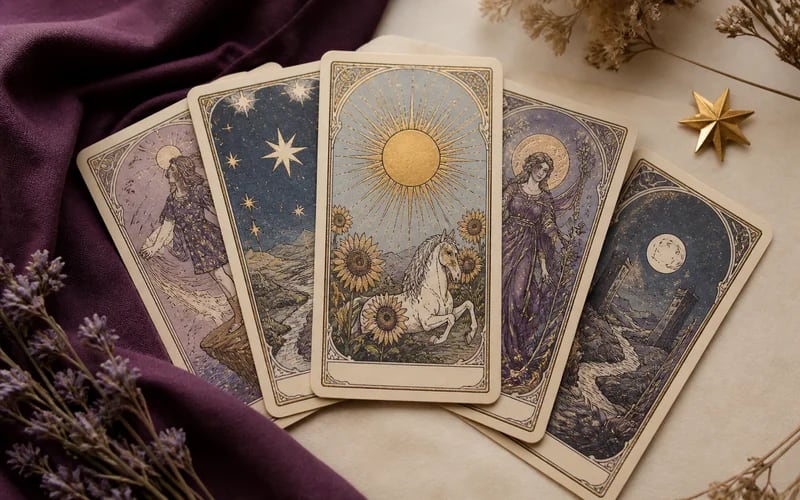
Tarot symbolism is not a fixed code in which every colour, animal or direction always means the same thing. A more useful approach is to describe what you can see, notice how the details relate to one another, check your deck’s guidebook or a named source, and then connect one relevant clue to your question.
This method lets you work with tarot imagery without turning every background detail into a message. It also keeps a clear line between what the card shows, what a source says and what you are interpreting for the situation in front of you.
What tarot symbolism can—and cannot—tell you
A symbol is a detail that can carry an association beyond its literal appearance. Imagery is the whole visual scene: figures, objects, setting, colour, movement and composition. A visual pattern repeats or creates a noticeable contrast across two or more cards.
These are starting points for interpretation, not universal translations. Tarot artwork changes between decks. The Victoria and Albert Museum’s history of tarot cards shows how varied tarot imagery has been and explains the lasting influence of Pamela Colman Smith’s fully illustrated Minor Arcana in the Rider–Waite–Smith deck.
That history matters when you read. A detail described in a Rider–Waite–Smith reference may be absent, reversed or deliberately reimagined in your deck. Begin with the picture in your hand. If your deck has a guidebook, use it to learn what its creator chose to emphasise.
Symbolism can help you form a reflective question or possible interpretation. It cannot prove what another person thinks, reveal an unknown fact or guarantee that an event will happen.
Read a tarot image in four passes
The four passes below move from evidence to interpretation. You can use them with one card or with each card in a small spread.
1. Describe what is visible
Before reaching for a meaning, write one or two plain observations.
Look for figures, animals, objects, setting, visible movement and the detail that caught your attention first.
Keep this pass literal. “A figure holds a lantern” describes an image. “The figure knows the answer” is already an interpretation.
You do not need to inventory every mark on the card. Choose details you can describe confidently. If a shape is unclear, call it unclear rather than turning it into a symbol.
2. Locate relationships, movement and contrast
Now ask how the details work together. Is a figure approaching, leaving or standing still? Is the scene open or enclosed? Are figures interacting or separated? Notice repeated objects and contrasts such as light and dark, near and far, or stillness and movement.
These features do not assign meaning by themselves. A figure looking left is not automatically the past, and a dark sky does not predict trouble. They become useful only when considered with the question, position and source meaning.
Context also matters within a single card. A symbol held carefully may suggest a different line of enquiry from the same symbol being dropped, hidden or placed far away. Beth Maiden’s introduction to tarot symbolism offers similar questions about who holds an object, what it is doing and how it interacts with the rest of the scene.
3. Check a deck-specific source
Consult your deck’s guidebook before assuming that a familiar symbol keeps the same meaning everywhere. Note the card name, orientation and one source-based theme that relates to your question.
If your deck follows Rider–Waite–Smith imagery, a source written for that tradition can help. Otherwise, use it only for comparison.
You can also use the InnerSigns tarot card library as a reference. Compare its visual description and themes with your actual card. When they differ, keep the difference visible in your notes instead of quietly importing an absent detail.
Try labelling your notes:
- Seen: what is visible in this card.
- Source: what this deck’s guidebook or a named reference says.
- Association: what the detail brings to mind for you.
A personal association can be useful; the label stops it being mistaken for the artist’s intention or an established fact.
4. Connect one clue to the question
Return to the exact question and the role assigned to the card. A symbol does not need to explain the whole situation. Choose one clue that helps you consider the position.
Use a sentence such as:
The image shows ____. My source associates this card with ____. In this position, one possibility is ____ because I already know ____ about the situation.
The final part should come from information you genuinely have. If your interpretation depends on an unanswered email, an unknown cost or someone else’s private feelings, mark that information as unknown.
Add an alternative when another reading fits. This shows where the image ends and your judgement begins.
How to notice visual patterns across several cards
Read each card in its assigned position before scanning the spread. This stops an eye-catching pattern from overriding the positions.
Then look for one of five relationships:
- Repetition: the same object, setting, colour or action appears more than once.
- Contrast: one card is still while another is active, or one is enclosed while another is open.
- Progression: the assigned positions and images together suggest a possible sequence.
- Interaction: figures appear to face towards, away from or past one another.
- Structure: suits, numbers or court ranks repeat.
Treat these as prompts. A repeated colour may be striking without having one agreed meaning. Figures facing each other do not prove that two real people will meet. A left-to-right arrangement becomes a timeline only when the positions establish one.
If the pattern involves suits, numbers or court ranks, the Minor Arcana guide provides a starting structure. Return to the individual cards afterwards; a shared number or suit does not erase their differences.
It is also fine to find no useful visual pattern. Keep the cards separate rather than forcing a connection.
Hypothetical worked example: stillness and motion
This is an invented scenario with deliberately selected cards. It is not a real draw or a prediction. The example uses Rider–Waite–Smith imagery and two positions created for this exercise.
An organiser is preparing a small community event. Their checklist is incomplete because details are scattered across several messages. The venue has not yet confirmed one arrangement, but no urgent decision is required in the next few minutes.
Their question is: “How could I approach the final preparations for the event?”
The two positions are:
- What could support my approach? — Four of Swords, upright.
- What action could I consider next? — Eight of Wands, upright.
Pass 1: describe the cards
In A. E. Waite’s Four of Swords entry, the figure is an effigy of a knight in a prayerful pose on a tomb. Waite includes retreat, solitude and repose among the card’s associations. Calling the figure a sleeping organiser or diagnosing exhaustion would add something the source does not establish.
Waite’s Eight of Wands entry describes wands in flight over open country and includes activity and swiftness among its associations. The image contains motion, but it does not prove that the venue will send a message.
You can compare these descriptions with the InnerSigns pages for the Four of Swords and Eight of Wands, while keeping the example tied to the imagery named above.
Pass 2: notice the visual contrast
The clearest relationship is stillness beside motion. One image centres a reclining effigy; the other shows objects moving through an open landscape.
That contrast is an observation. It does not yet tell the organiser whether to pause or act, nor does it establish an order.
Pass 3: add the positions and source themes
The positions provide the order of thought. Retreat or repose appears in support, while activity appears in next action.
One possibility is that a brief pause could support a purposeful action. This comes from the selected source themes and roles; it is not a universal meaning for the pair.
Pass 4: connect the pattern to known circumstances
The organiser already knows that the information is scattered. They could gather the messages, update the checklist and send one factual summary, leaving the venue item marked pending.
The scenario—not the cards—supplied the fact about scattered messages. The visual contrast shaped a possible sequence: pause to organise, then communicate clearly.
An alternative also fits. The organiser could review the checklist alone, then complete one task that does not depend on the venue. They can choose between these ideas using the real deadlines and responsibilities, or decline both.
A complete note might read:
- Seen: a still figure; wands in motion.
- Source: retreat or repose; activity or swiftness.
- Pattern: stillness contrasted with movement.
- Possible connection: organise the known information before sending an update.
- Alternative: use the pause to identify and finish one independent task.
- Unknown: whether or when the venue will confirm.
- Chosen action: check the messages and update the shared list.
The interpretation produces a modest option within the organiser’s control. It does not predict the reply or the event’s outcome.
Common mistakes when reading tarot symbolism
Watch for these common errors:
- Using a symbol dictionary as a universal key: a list can supply ideas, but the same object may work differently across cards and decks. Check the scene and deck guidebook.
- Importing details from another deck: do not describe a mountain, animal or gesture as visible because it appears in a famous version of the card.
- Fixing meanings to colour or direction: colour, gaze and placement can support comparison; they do not automatically establish emotion, time or causation.
- Making every detail significant: choose one or two clues that contribute to the reading. Leave scenery or ambiguity uninterpreted when appropriate.
- Changing the spread after seeing the cards: keep the original question and position labels visible rather than moving a card into a more convenient role.
- Treating imagery as evidence about a person: a gesture on a card cannot confirm someone’s motives, feelings or consent. Obtain external information directly.
If you need the complete process around asking a question, drawing and recording a reading, use the beginner’s guide to reading tarot cards.
Practise with one small visual note
Choose one card from your deck. If you want to compare cards, use two or three and keep their positions visible.
Write five lines:
- What I can see.
- What repeats or contrasts.
- What my deck’s guidebook or named source says.
- One possible connection to the question and position.
- What remains unknown.
Finish with one modest action, if any action is useful. You can also write “no clear connection yet” and stop.
For a fresh practice layout, try the three-card reading. It uses Past, Present and Next step positions and draws random upright cards. The tool supplies card meanings and prompts; you decide whether a visual relationship is useful. Keep your notes separately, because refreshing the page loses the reading.