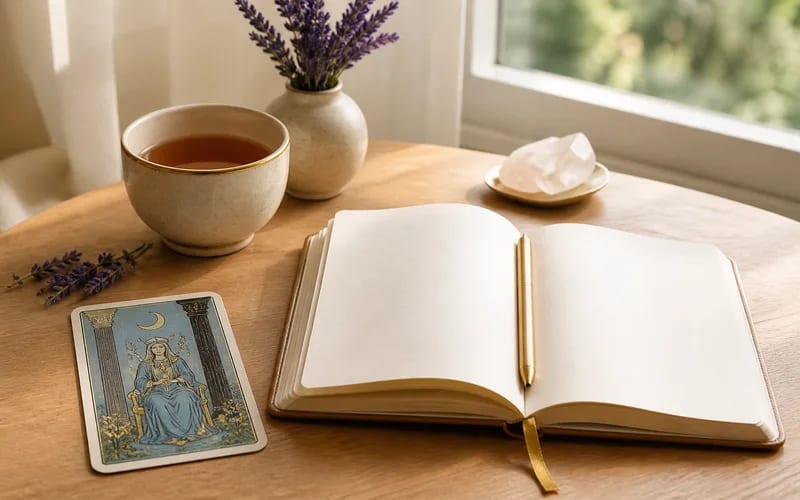
A daily tarot practice can be simple: choose one reflective question, draw one card, record what you notice, and consider one possible connection to your day. If you return to the note later, compare the interpretation with what actually happened rather than making events fit the card.
The aim is not to predict the day or maintain a perfect streak. It is to create a small, repeatable pause in which you can examine a question while keeping your own knowledge and judgement central.
Decide what you want the practice to do
Before drawing, choose a modest purpose. You might want to become more familiar with your deck, notice how you approach an ordinary situation, or give yourself one question to consider during the day.
Keep the task within the card’s limits. Tarot can offer an image or theme to think with, but it cannot establish what another person feels, tell you whether an event will happen, or supply facts you need to check elsewhere.
Try a question such as:
- What deserves my attention as I approach today?
- What quality could I practise in this situation?
- What might help me respond thoughtfully?
- What am I assuming, and what do I actually know?
If you are learning the mechanics of questions, drawing, and looking up meanings, begin with how to read tarot cards. A daily practice adds repetition and review; it does not require a different way of shuffling or a more complicated spread.
“Daily” is an available rhythm, not a rule. Missing a day does not create a debt to repay. You can return when the practice feels useful.
Use a four-part reflection loop
One card is enough for this exercise. Keeping the reading small makes it easier to see where each part of your interpretation came from.
1. Set the scope
Write down your question before drawing. If it concerns a particular situation, include one or two facts you already know.
For example, “I have a meeting this afternoon and have not prepared my questions” gives the card a clear context. It also preserves the known fact: the questions still need preparing, whatever card appears.
2. Draw once and observe
Draw one card and record its name and orientation. Before opening a guidebook, describe one visible detail: an object, expression, gesture, colour, or contrast.
Keep the description plain. “A figure looks closely at an object” is an observation. “I need to concentrate” is already an interpretation.
There is no need to decode every symbol. If the image gives you little to work with, note that and move to a reference.
3. Interpret provisionally
Consult your deck’s guidebook or a suitable card reference and choose one theme that relates to your question. Then explain the connection using something you know about your circumstances.
Helpful wording includes:
This source associates the card with ____. In my situation, that could invite me to consider ____ because ____.
The final blank keeps the reasoning visible. A reference can establish what its author says about a card; it cannot verify that the application is correct for you.
For more practice separating imagery, reference meanings, and personal associations, see how to interpret tarot cards in context.
4. Close the reading
Write one possible interpretation and, if useful, one manageable action. Then name something the card cannot tell you.
Your action might be to prepare a question, check a date, take a short break, or begin one small part of a task. It can also be “no action for now”. The reading does not have to produce an instruction.
A compact entry can use these fields:
| Field | What to record |
|---|---|
| Date and time | When you made the entry |
| Question | The exact prompt you used |
| Card | Name and orientation |
| Observation | One visible detail from your deck |
| Source theme | A relevant meaning from a named guide or reference |
| Possible application | How the theme might relate to a known circumstance |
| Unknown | What the card does not establish |
| Optional action | One small step within your control |
This can be a few lines in a notebook or notes app. A dedicated tarot journal is optional.
Hypothetical worked example: Page of Pentacles and a focused start
This is an invented scenario with a deliberately selected sample card. It is not a real draw or prediction.
Imagine a learner who has scheduled a study session after work. Their notes and reading list are ready, but they have not decided which task to begin with.
Their question is: “What quality could help me begin this study session?”
The sample card is Page of Pentacles, upright, in the position Your focus.
Separate the source from the situation
In A. E. Waite’s Page of Pentacles entry, the figure looks intently at a pentacle. Waite lists application, study, scholarship, and reflection among the card’s associations.
That establishes one source’s description and tarot convention. It does not establish what the learner must do, how their session will go, or whether every deck presents the Page in the same way. A reader using different artwork should describe the image in front of them.
The learner could explore focused application as a theme because their materials are already prepared and their immediate difficulty is choosing a starting point. Those circumstances come from the hypothetical scenario, not from the card.
One possible action is to choose a single item from the reading list, work on it for the first planned block, and then decide what comes next. The card has not predicted that the learner will concentrate or complete the task.
Their note might read:
- Question: What quality could help me begin this study session?
- Card: Page of Pentacles, upright.
- Observation: The figure is looking closely at the pentacle held before them.
- Source theme: Waite includes application and study among the card’s associations.
- Possible application: Give my attention to one prepared task instead of continuing to choose between them.
- Unknown: How much I will complete or whether this approach will suit me tonight.
- Action: Start with the first article on my reading list and reassess after the planned block.
The reader could later add: “I began the article but needed to stop halfway,” or “The focused start was useful.” Either note is allowed. The evening record does not need to prove the interpretation right.
You can compare this example with the InnerSigns Page of Pentacles meaning, while keeping the reference, scenario, and application distinct.
Choose a morning or evening version
The best time is the one that suits the kind of reflection you want. Morning and evening practices ask slightly different questions.
| Version | Begin with | Optional later note |
|---|---|---|
| Morning | A question about your approach to something ahead | Record what actually happened and whether the interpretation was useful |
| Evening | A known event or response from the day | Note a perspective the card helped you consider |
For a morning draw, avoid writing a forecast and then searching all day for confirmation. Carry the question lightly, and let unrelated events remain unrelated.
For an evening draw, start with the facts before introducing the card. “I postponed the call” is a known event. “The card explains why I postponed it” is an interpretation and should be written as one.
On a busy day, use a minimum version: record the card, one observation, and one question. You can stop there. On another day, you may want a longer entry. Both count as complete practices.
Review your journal without forcing a pattern
After several entries, read a small group of them together. The purpose is to examine how you interpreted, not to make the cards prove a story about your life.
Ask:
- Which interpretations were useful, irrelevant, or still unclear?
- Did I distinguish what I observed from what a source said?
- Did I add facts that the card could not have supplied?
- Did the action fit what I could realistically influence?
- Am I repeatedly asking the same question without seeking the information I need?
If a card repeats, record the different dates, questions, and responses. The repetition alone does not establish an objective message. The same card may lead to different reflections in different contexts, and you do not have to resolve those differences.
For a close review, label each sentence in one entry as observation, source, application, or later fact. If a sentence crosses categories, rewrite it more precisely. “The card showed that my colleague was avoiding me” could become: “The image prompted me to wonder whether I was feeling avoided; I still need to speak with my colleague if the issue matters.”
It is also useful to leave “unclear” in the record. An interpretation does not become more accurate because it is confident.
Know when to pause
A daily practice should remain optional. Pause if you notice yourself drawing repeatedly for reassurance, treating an uncomfortable card as a warning, or asking the deck to settle a decision that needs evidence or qualified advice.
You can return to neutral card study, use the imagery as a writing prompt without applying it to your life, or put the deck away. Skipping the practice is always available.
For questions about health, safety, money, law, or another person’s intentions, obtain the relevant information directly. Tarot can help you notice a question you want to ask; it cannot provide the answer on someone else’s behalf.
Practise with InnerSigns
You can try a one-card reflection when you do not have a physical deck. The tool prepares one random upright card in the Your focus position and lets you add an optional short intention before revealing it.
Use the same reflection loop: observe the image, read the supplied meaning, make a provisional connection, and name what remains unknown. The tool does not write an interpretation for your circumstances or save a journal. Keep your note separately, because resetting or refreshing creates a new reading and the previous result is not preserved.
You cannot select the Page of Pentacles from the hypothetical example on demand. If you draw another card, work with that card or browse the tarot card library for study without treating the example as a result you need to reproduce.
A complete daily practice can remain very small: one question, one card, one clearly explained possibility, and one honest note. What matters is not making the day obey the card. It is keeping your interpretation open to review while your judgement and the facts remain in charge.